
Regulators Block Amazon Nuclear Power Deal


Big Tech’s insatiable quest for abundant energy continues to accelerate with the advent of AI and the subsequent expansion of large-scale data centres required to process the ever-growing monolith of online information. However, the challenge for the companies investing in this infrastructure, like Amazon and Google, is that they are run by woke executives appealing to woke investors, bankers, and the public.
Consequently, they cannot simply fire up a coal plant to power their growing army of data centres. So, they are bound to seek green-energy pastures, which, let’s face it, are unreliable and inadequate. Wind and solar, for example, produce energy intermittently, which is problematic for data centres that require constant 24/7 supply.
Thus, the need for abundant power that comes from carbon-free sources has left Big Tech with a bit of a pickle. Renewable sources are simply not going to cut it, and investing in fossil fuels is a big no-no - leaving only one remaining carbon-neutral alternative: nuclear. At least that seems to be the reasonable course.
To be sure, nuclear itself has a bad rap with environmentalists for its troubled history of plant meltdowns, radioactive waste and three-eyed fishes (Simpsons reference).

But those worries seem to pale in comparison to the alleged existential threat that
climate-hysterics warned us would melt the ice caps years ago. And while planetary annihilation goal posts have been moved back, carbon dioxide is still at the top of every environmentalist’s kill list. In fact, it is precisely in the context of climate change that nuclear power has once again become en vogue. Even Japan has affirmed plans to restart its array of decommissioned nuclear plants previously shut down after its infamous Fukushima disaster some 13 years ago. But that’s water under the bridge.
With a renewed interest, the nuclear industry itself is undergoing a transformation, focusing innovation on new technologies such as nuclear fusion as well as small modular reactors (SMRs). These SMRs promise to deliver big power, with a small footprint, and less costs. Moreover, the modular design allows for installation in almost any location. Indeed, Amazon, Google and even OpenAI have all made significant investments in SMR-focused nuclear companies such as X-Energy, Kairos Power and Oklo. However, even the earliest of estimates do not see functional SMRs in the US until at least 2030. In the meantime, the next best solution sought by Big Tech has been to tap into or restart traditional large-size nuclear facilities, such as Microsoft’s recent deal with Constellation Energy is likely to see.
That deal is set to power one of Microsoft’s AI data centres from the decommissioned Three Mile Island nuclear plant in Pennsylvania. Three Mile Island, for those that may not know, suffered its own meltdown many years ago and has been abandoned since.
However, it would be Amazon’s recent attempt to tap into the operational Susquehanna nuclear plant, also located in Pennsylvania that would first run into regulatory hurdles, and surprisingly none of the push back is environmental!
Earlier this year a subsidiary of Amazon purchased Talen Energy’s nuclear-powered data centre for $650m. The 1,200km2 campus is directly powered by Susquehanna nuclear plant, the 6th largest nuclear plant in the US. Amazon intends to build its newest data centre on the campus, powered directly from Susquehanna.
While the deal itself was not opposed by regulators, a subsequent amendment on how the plant’s power would be supplied to the new data centre was rejected by the Federal Energy Regulatory Commission (FERC). The proposed amendment to the interconnection service agreement involved increasing the power allocation from Talen Energy’s Susquehanna nuclear plant to Amazon’s data center from 300 to 480 megawatts. This increase would allow Amazon’s AWS data center to meet its higher power demands directly from the plant’s 2.5-gigawatt output, bypassing the need for extensive transmission on the grid. This is referred to as a collocated arrangement, in which power is supplied "behind the meter," meaning the facility bypasses some of the standard grid infrastructure and potentially some associated transmission costs.
This can increase efficiency by reducing transmission losses and, in some cases, minimizing grid congestion. Improved efficiency and reduced grid congestion sounds good to any sensible businessman, but not according to the regulators.
The FERC sees the opposite, claiming that this amendment can disrupt standard billing practices, grid reliability, and equity in electricity pricing. Ah yes, equity!
And, they say collocating a data center with a nuclear facility introduces unique safety, regulatory, and operational challenges that require thorough justification and planning. According to the FERC the amendment was not sufficient in justifying the need for this “non-standard” arrangement and failed to prove its necessity. Ultimately the FERC rejected the interconnection agreement specifically citing how the arrangement would raise the power bills for the public and affect the grid’s reliability.
But is that actually true?
On the surface it may appear logical as there is only so much power a nuclear plant can generate. If along comes another customer like Amazon that wants a bigger piece of that pie, then there is simply less for everyone else, right?
And if Amazon gets cheaper prices while taking more of the supply, the thinking is that everyone else must pay more. Thank God for the regulators.
This logic, however, is untenable.
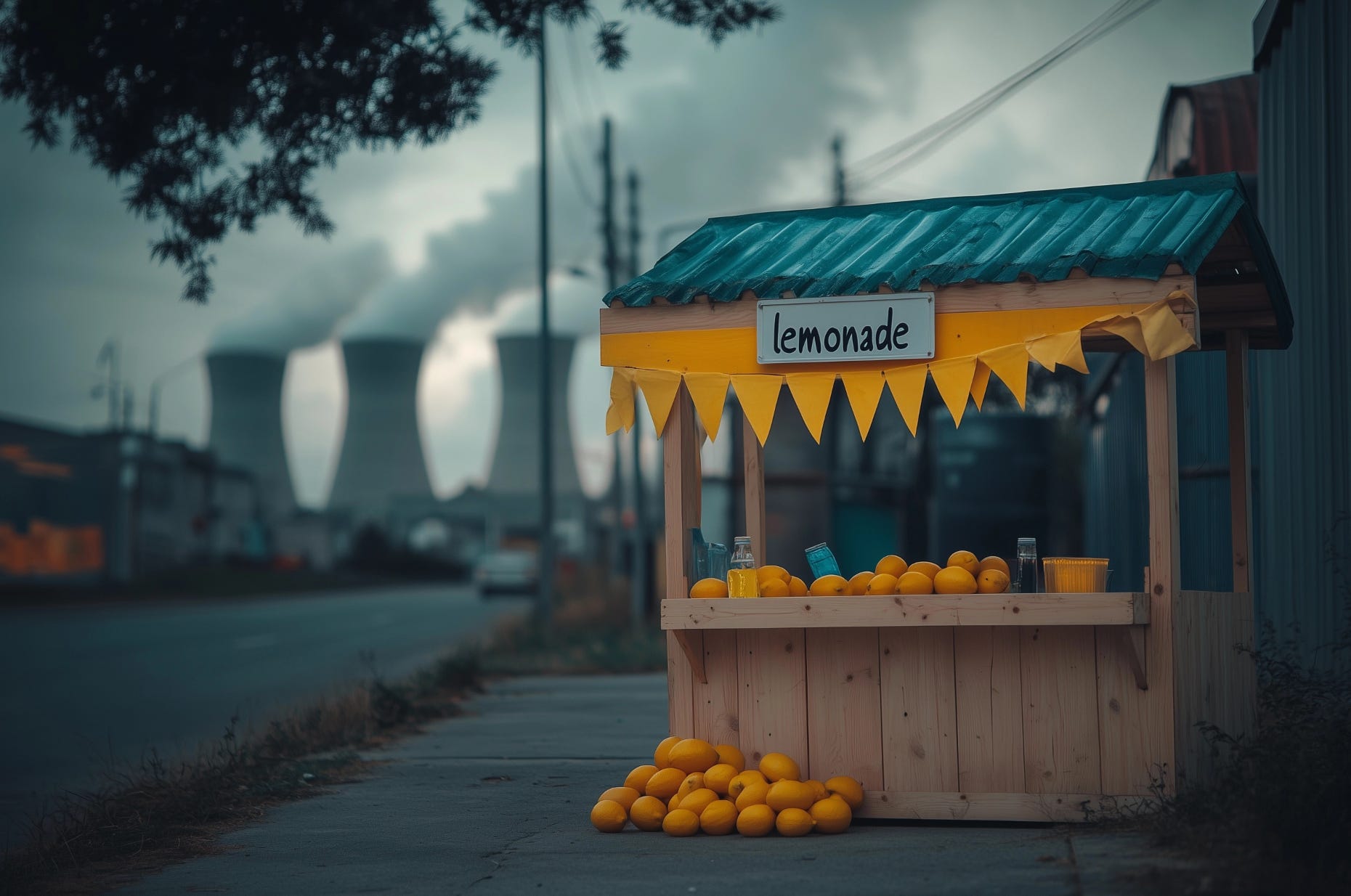
To understand why this intervention, like all government interventions, is doomed to achieve the opposite of its stated goal, let’s use a simple analogy: the lemonade stand. Suppose it’s a hot summer, and every day the lemonade stand satisfies about 100 sugary-drink customers. Then one day the owner of the stand is approached by a nearby sports team who is interested in buying 50 lemonade drinks of its own every single day. However, the team does not require 50 individual drinks, with 50 individual cups, but rather a large pitcher that contains just as many drinks. The sports team requests a price discount due to the large volume and simplicity of the order.
The lemonade stand accepts the deal, of which shortly after regulators step in. The regulators calculate that the stand is really only capable of producing 100 drinks a day, maybe 120, but certainly not 150. They conclude that if the sports team takes those 50 drinks every day without fail, then there will be days in which other customers will be left thirsty. Or they will be forced to pay price gouging levels for their lemonade because of the shortfall while the sports team gets a discount.
Thus, the regulators block the deal, forcing the sports team to search elsewhere for their drinks, all in the name of protecting the existing consumers.
With our analogy now in place, let’s think through what would likely happen if there was no regulatory intervention. Assuming there is demand now for ~150 drinks, which is more than the stand can produce at current capacity, the most likely thing to occur is that the stand would find a way to increase its capacity to meet that demand.
If there were real physical limitations preventing that, you can rest assured that another lemonade stand would open up across the street to capitalize on all these thirsty summer drinkers. That’s how free markets work. If there is demand for a good or service that is beyond the capacity of a producer or producers in a given market, it is specifically that demand that becomes the driving force behind investment, expansion, innovation, productivity increases, efficiency improvements and the like.
An unsatisfied demand is like a neon flashing dollar sign for the clever entrepreneur.

Investment is the rocket fuel for growth. If the entrepreneur invests and anticipates demand correctly, he stands to gain. That’s how wealth is actually ‘created.’
In the case of our lemonade stand example, the new demand from the sports team is certainly not something that is bad for business or bad for the consumer
But what about the temporarily higher prices you say? You may be thinking that if demand outpaces supply, then the regular consumer will inevitably be stuck with paying more. However, this is a misconception. Prices form naturally in a free market as a way to balance out supply and demand. If there truly is more demand for lemonade than there is lemonade available, and if there is in fact no possible way for producers, or competitors to make more of it, then yes prices would increase.
But it would not last unless it wasn’t a very attractive margin.
When a situation like this occurs it ensures only those who actually need lemonade the most get it. Perhaps iced tea or Kool-Aid stands emerge on the market as a cheaper alternative to thirsty consumers. Or perhaps the existing lemonade stand would find ways to produce more lemonade, more efficiently and at a cheaper rate.
This is because the drive to improve efficiency, or spur competition is entirely coming from the increase in demand to begin with. This is an important point. The increased demand for thirst-quenching beverages and rising prices is the signal for the market to make more, which leads to innovation, more choices, lower costs and cheaper prices. In the end, all the summer drinkers benefit from the sports team’s deal.
There is more lemonade, or other such beverages available for everyone, more options, and better prices. Moreover, after satisfying the needs of one sports team, other teams may also show interest, further snowballing the movement and creating even more opportunities for both consumers and producers. Demand is good!
In a free market system, the demand for something ensures its sustainability. Flipping back to the Amazon’s nuclear deal, the lemonade stand logic is identical.
With AI data centers, Big Tech, and even Bitcoin miners all becoming new energy customers with growing demand, the world is destined to move towards more energy abundance with cheaper costs. Why? Because this new demand is the motivation for producers to seek advances in technology. It is what inspires new entrepreneurs and new competitors to enter the market. Or at the very least, this is what sparks existing producers to improve their operations. This is already evidenced with the billions invested in SMRs and nuclear fusion reactors. If there was not demand for more and more power, why would anyone invest in these technologies? And if these technologies prove successful, everyone benefits, not just the Amazons or Microsofts of the world. In fact, because these companies are footing the bill for the research and development, the average consumer is able to benefit from the end result without any risk or upfront cost themselves. This is the beauty of the free market.
Back to our lemonade stand example, consider the outcome if the regulator successfully blocks the sport team’s deal. Well for starters the sports team is left thirsty. But for the average lemonade consumer, nothing much changes. They can still get their lemonade as normal. But are they better off? Without the demand from the sports team, there is no reason for competitors to open up, or for the existing lemonade stand to innovate or improve its operation. The consumer does not benefit.
Competition, and therefore choices remain limited. Still only lemonade, no iced tea or Kool-Aid. In terms of producers, the lemonade stand does not see any extra business or revenue. It loses both the deal, and an opportunity to grow. Importantly, the reason we need entrepreneurs is that things are always changing. It is the same case in the world of nuclear power generation. When regulators block deals like this, despite their belief in the opposite, the consumer is not better off. There is no impetus for Big Tech or nuclear power companies to innovate. The consumer is stuck with the same situation as before, only they also have to pay for the regulators to ‘protect’ them!
Free, unhampered economies naturally incentivize entrepreneurs to meet the changing demand of consumers. The more demand there is for something scarce, the more opportunity, the more growth, the more options available to consumer while prices come down if someone invests in producing it. Both the producer and consumer win.